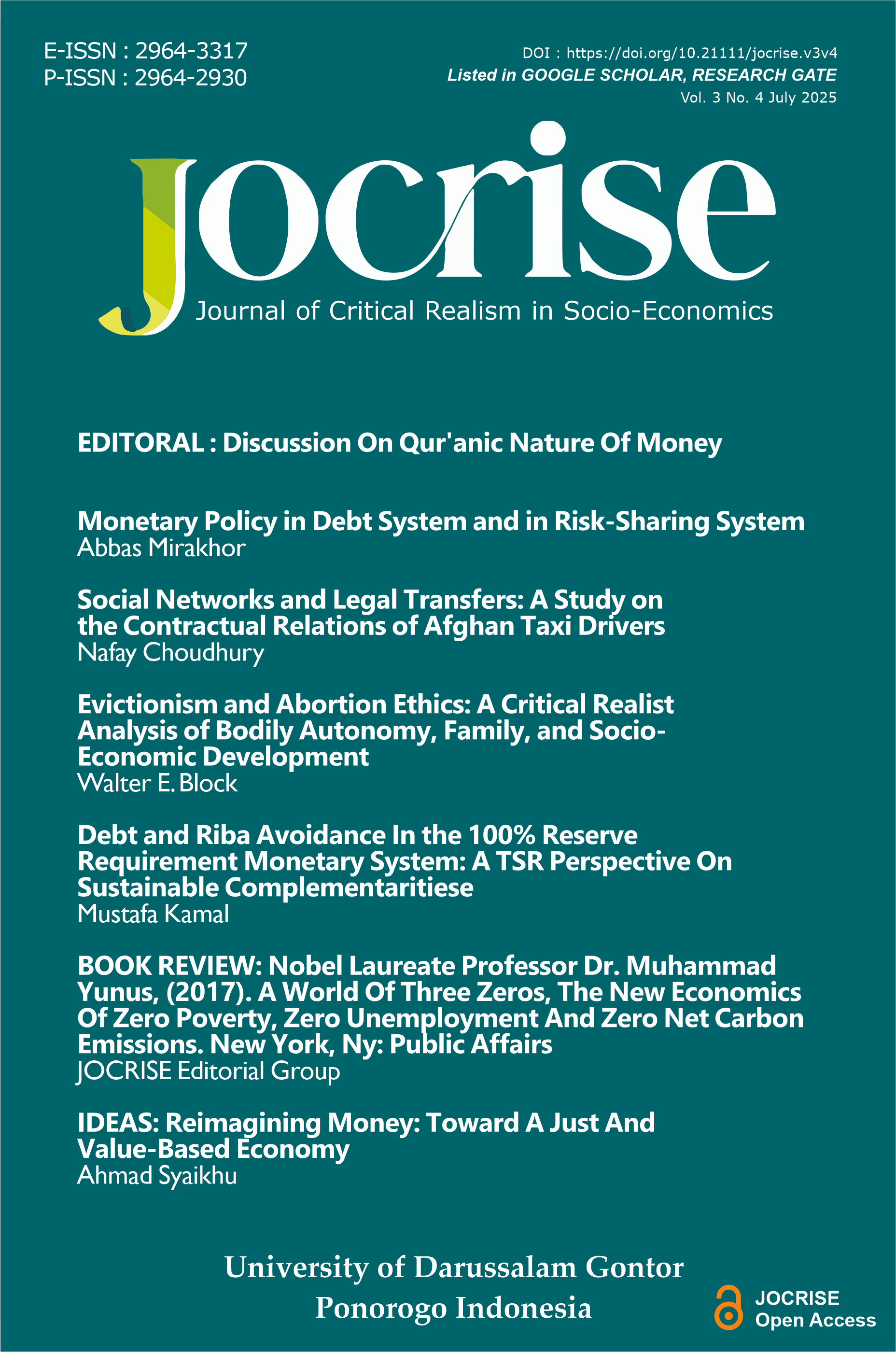
Debt And Riba Avoidance In The 100% Reserve Requirement Monetary System: A TSR Perspective On Sustainable Complementarities
DOI:
https://doi.org/10.21111/jocrise.v3i04.88Keywords:
100% reserve banking, riba avoidance, Tawhidi String Relations (TSR), Islamic finance, monetary reformAbstract
This paper explores the systemic roots of debt and riba (interest) in conventional monetary systems and presents a morally grounded alternative based on the Tawhidi String Relations (TSR) framework. Within the prevailing fractional reserve system, money creation through debt issuance has led to financial instability, speculative cycles, and wealth concentration—dynamics that conflict with the foundational principles of Islamic economics, particularly the prohibition of riba and the imperative for distributive justice. In response, the paper proposes a 100% reserve requirement monetary system that aligns with TSR’s epistemology of unity (tawhid), emphasizing complementarity between ethics, economic institutions, and real sector activities. The study argues that under the TSR framework, money is not a neutral tool but a moral instrument tied to real value creation and governed by ethical purpose. Through the principles of circular causation and knowledge-ethics-action integration, the full reserve system facilitates participatory finance, eliminates the structural basis for riba, and enhances financial inclusion and macroeconomic stability. Banks are reconceptualized as ethical intermediaries operating through profit-and-loss sharing contracts, while investments are directed toward socially beneficial and risk-shared ventures. Supported by both theoretical rigor and empirical evidence, this paradigm offers a holistic, sustainable, and shari‘ah-compliant alternative to debt-based finance. Ultimately, the TSR-aligned full reserve model offers not only a monetary reform, but a civilizational shift toward a justice-oriented Islamic economic order.
References
Asutay, M. (2012). Conceptualizing and locating the social failure of Islamic finance: Aspirations of Islamic moral economy vs. the realities of Islamic finance. Asian and African Area Studies, 11(2), 93–113.
Benes, J., & Kumhof, M. (2012). The Chicago Plan Revisited. IMF Working Paper No. 12/202. https://doi.org/10.5089/9781475505528.001
Chapra, M. U. (1985). Towards a Just Monetary System. The Islamic Foundation.
Choudhury, M. A. (2007). The Universal Paradigm and the Islamic World-System. World Scientific.
Choudhury, M. A. (2008). Islamic Economics and Finance: An Epistemological Inquiry. Emerald Group Publishing.
Choudhury, M. A. (2011). Islamic Economics and Finance: An Epistemological Inquiry. Emerald Insight.
Choudhury, M. A., & Hossain, M. A. (2006). The Contrasting Foundations of Islamic Economics and Western Neoclassical Economics. Islamic Economics and Finance Series.
Fisher, I. (1935). 100% Money. The Adelphi Company.
Jackson, A., & Dyson, B. (2012). Modernising Money: Why Our Monetary System is Broken and How it Can be Fixed. Positive Money.
Kammer, A., et al. (2015). Islamic Finance: Opportunities, Challenges, and Policy Options. IMF Staff Discussion Note.
Mirakhor, A., & Krichene, N. (2009). The recent crisis: Lessons for Islamic finance. IFSB 2nd Public Lecture on Financial Policy and Stability.
Werner, R. A. (2014). Can banks individually create money out of nothing? — The theories and the empirical evidence. International Review of Financial Analysis, 36, 1–19.
Downloads
Submitted
Accepted
Published
How to Cite
Issue
Section
License
Copyright (c) 2025 Mustafa Kamal

This work is licensed under a Creative Commons Attribution-ShareAlike 4.0 International License.