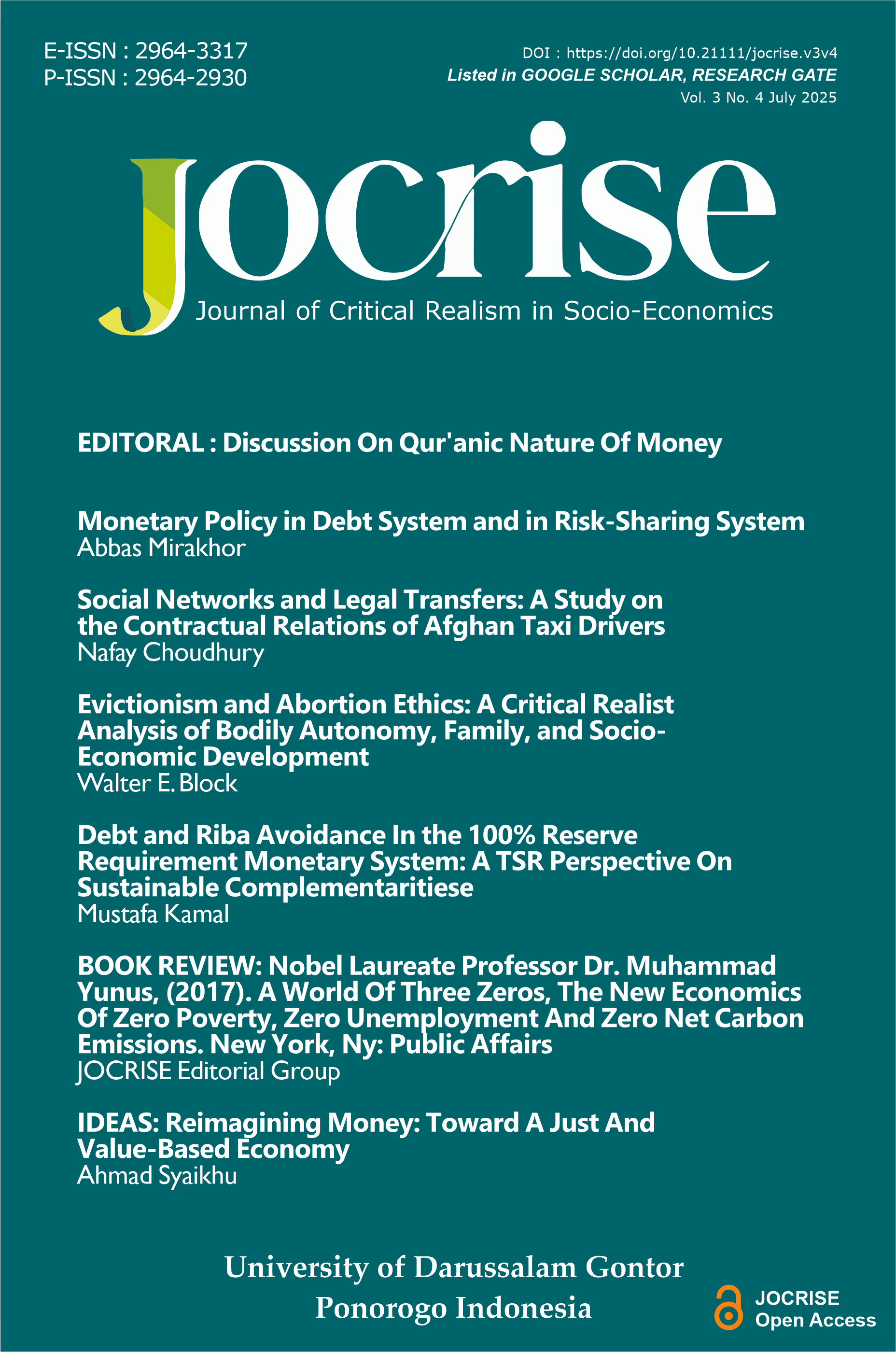
Social Networks and Legal Transfers: A Study on the Contractual Relations of Afghan Taxi Drivers
DOI:
https://doi.org/10.21111/jocrise.v3i04.87Keywords:
legal transfers, social networks, informal norms, Afghanistan, taxi driversAbstract
This study examines the phenomenon of legal transfers in developing countries through the lens of social network analysis, using the case of Afghan taxi drivers to explore the interaction between formal legal reforms and embedded social norms. Drawing on field research conducted in Kabul, the paper investigates how taxi drivers conduct their contractual affairs in the context of a weak formal legal system. Despite significant international efforts to transplant formal contract law regimes and strengthen judicial institutions in Afghanistan, the findings reveal that formal law plays a minimal role in regulating everyday transactions. Instead, drivers rely heavily on social networks—particularly guarantors—whose legitimacy stems not from state authority, but from trust and reputation within the community. Intriguingly, these guarantors increasingly include government-affiliated individuals, whose bureaucratic registration makes them traceable and thus pragmatically valuable, while still operating within informal norms. The paper argues that rather than replacing traditional norms, legal reforms have been absorbed into existing social networks, resulting in a hybrid regulatory model. This underscores the resilience of local social structures and challenges conventional assumptions in law and development discourse that equate legal reform with normative transformation. By introducing social network analysis into legal transfer studies, the paper provides a more nuanced framework to understand how legal ideas are localized, reinterpreted, or resisted. The study ultimately advocates for greater contextual sensitivity in assessing the impact of legal transfers, recognizing that recipient environments are governed not merely by legal institutions but by complex webs of interpersonal relationships and social meaning.
References
A. Watson, ‘Comparative Law and Legal Change’, (1978) 37 Cambridge Law Journal, 313–15.
B. Garth. (2001). ‘Rethinking the Processes and Criteria for Success’ in R. V. Van Puymbroeck (ed.), Comprehensive Legal and Judicial Development .World Bank.
Bali, Ash. U. (2005). ‘Justice Under Occupation: Rule of Law and the Ethics of Nation-Building in Iraq’ 30 Yale J. Int'l L
Banakar, R, and M Travers (eds.). (2013). Law and Social Theory (2nd edn, Hart Publishing)
BAP. (2007). Borrowing Court Systems: The Socialist Experience of Vietnam. Brill Academic Publishers 2007
Barfield T. (2008). ‘Culture and Custom in Nation-Building: Law in Afghanistan’. Maine Law Review.
Barfield T. (2010). Afghanistan: A Cultural And Political History. Princeton University Press.
Bernstein L. (1992). ‘Opting Out of the Legal System: Extralegal Contracting in the Diamond Industry’ Journal of Legal Studies.
Carrington PJ and Scott J. (2011). ‘Social Network Analysis: An Introduction’ in John Scott and Peter J Carrington (eds), The SAGE Handbook of Social Network Analysis. Sage
Casciaro, T., K.M. Carley, and D. Krackhardt. (1999). ‘Positive Affectivity and Accuracy in Social Network Perception’. Motivation and Emotion
Choudhury N. (2014). ‘Pluralism in Legal Education at the American University of Afghanistan’ Suffolk Transnational Law Journal.
Choudhury N. (2017). ‘Revisiting Critical Legal Pluralism: Normative Contestations in the Afghan Courtroom’. Asian Journal of Law and Society.
Civil Code of Afghanistan, Official Gazette 353, No. 4, 15 Jadi 1355 (5 January 1977).
Clay K. (1997). ‘Trade Without Law: Private-Order Institutions in Mexican California’ Journal of Law, Economics, and Organization.
Clyde Mitchell. (1969). The Concept and Use of Social Networks, in Mitchell JC, Social Networks in Urban Situations: Analyses of Personal Relationships in Central African Towns. Manchester University Press.
D. Nelken and J. Feest (eds.). (1997). Adapting Legal Cultures (Hart Publishing 2001). P. Legrand, ‘The Impossibility of Legal Transplants’. Maastricht Journal of European Comparative Law.
David M Trubek and Alvaro Santos (eds). (2006). The New Law and Economic Development: A Critical Appraisal. Cambridge University Press.
de Soto H. (2002). The Other Path: The Economic Answer to Terrorism. Reprint edition, Basic Books.
Engel D and Engel J. (2010). Tort, Custom, and Karma: Globalization and Legal Consciousness in Thailand. Stanford University Press.
Foley C. (2011). A Guide to Property Law in Afghanistan. 2nd edn, Norwegian Refugee Council 2011.
Gillespie J and Nicholson P (eds), (2012). Law and Development and the Global Discourses of Legal Transfers Cambridge University Press
Gillespie, J. (1995). ‘Relocating global scripts in local networks’ at 39; Suchman, M ‘Managing Legitimacy: Strategic and Institutional Approaches’ Academy of Management Review.
Gillespie, J. (2012). ‘Relocating global scripts in local networks,’ in Gillespie J and Nicholson P (eds), Law and Development and the Global Discourses of Legal Transfers.Cambridge University Press.
Gomez M. (2007) ‘All in the Family: The Influence of Social Networks on Disputing Processing (A Case Study of a Developing Economy)’ Georgia Journal of International and Comparative Law.
Goyal S. (2009). Connections: An Introduction to the Economics of Networks. Princeton University Press.
Granovetter M. (1985). ‘Economic Action and Social Structure: The Problem of Embeddedness’. American Journal of Sociology.
Granovetter MS. (1973). ‘The Strength of Weak Ties’ 78 American Journal of Sociology 1360, .
Greif A. (1993). ‘Contract Enforceability and Economic Institutions in Early Trade: The Maghribi Traders’ Coalition’ American Economic Review.
Killworth P et.al. (1990). ‘Estimating the Size of Personal Networks’. Social Networks.
Macneil IR. (1978). Contracts: Exchange Transactions and Relations. Foundation Press.
Mark S. Granovetter. (1973), The Strength of Weak Ties,
Mejelle: A Complete Code of Islamic Civil Law (Islamic Book Trust, 2000).
Merry, S ‘Legal Pluralism’ (1988). Law and Society Review .
Merton RK. (1936). ‘The Unanticipated Consequences of Purposive Social Action’ 1 American Sociological Review 894.
Nelson M. (2011). In the Shadow the Shari’ah: Islam, Islamic Law, and Democrary in Pakistan. Hurst & Co.
North, DC. (1990). Institutions, Institutional Change and Economic Performance. Cambridge University Press.
Norwegian Refugee Council. (2007). ‘The Relationships Between the Formal and Informal Justice Systems in Afghanistan’. Norwegian Refugee Council .
Paquin J, (2008). ‘Cross-Cultural Business Law Transplants: The Neglected Issue of the “Fit”’. Transnational Law & Contemporary Problems 331.
Polanyi K. (1997). The Great Transformation. Beacon Press .
Rebecca Gang. (2010). ‘Community-Based Dispute Resolution Processes in Balkh Province’ (Afghanistan Research and Evaluation.
Rubin BR. (2002). The Fragmentation of Afghanistan: State Formation and Collapse in the International System. Yale University Press ;
See Mauss M. (1996). The Gift: Forms and Functions of Exchange in Archaic Societies. Ian Cunnison tr, Cohen & West .
SIGAR.(2015) “SIGAR 15-68 Audit Report: Rule of Law in Afghanistan—U.S. Agencies Lack a Strategy and Cannot Fully Determine the Effectiveness of Programs Costing More Than $1 Billion” (SIGAR.
Strahilevitz. (2005). L ‘A Social Networks Theory of Privacy. University of Chicago Law Review .
Suhrke, A and K Borchgrevink. (2009). ‘Negotiating Justice Sector Reform in Afghanistan’ Crime, Law, and Social Change.
Swenson G. (2017). ‘Why U.S. Efforts to Promote the Rule of Law in Afghanistan Failed’ International Security.
Tamanaha BZ. (2011). ‘The Primacy of Society and the Failures of Law and Development’. Cornell International Law Journal.
Van Rooij B and Nicholson P. (2013). ‘Inflationary Trends in Law and Development’ 24 Duke Journal of Comparative & International Law 297.
Watts, D. (1999). Small Worlds. Princeton University Press.
White DR. (2011). ‘Kinship, Class, and Community’ in John Scott and Peter J Carrington (eds), The SAGE Handbook of Social Network Analysis.
Williams RF. (1981). ‘Legal Education in Afghanistan Prior to the Soviet Occupation’ Transnational Law Journal 247; Choudhury ‘Pluralism in Legal Education’.
Yassari N and Saboory MH. (2010). ‘Sharia and National Law in Afghanistan’ in Michiel Otto (ed), Sharia and National Law: Comparing the Legal Systems of Twelve Islamic Countries. The American University in Cairo Press .
Downloads
Submitted
Accepted
Published
How to Cite
Issue
Section
License
Copyright (c) 2025 Nafay Choudhury

This work is licensed under a Creative Commons Attribution-ShareAlike 4.0 International License.