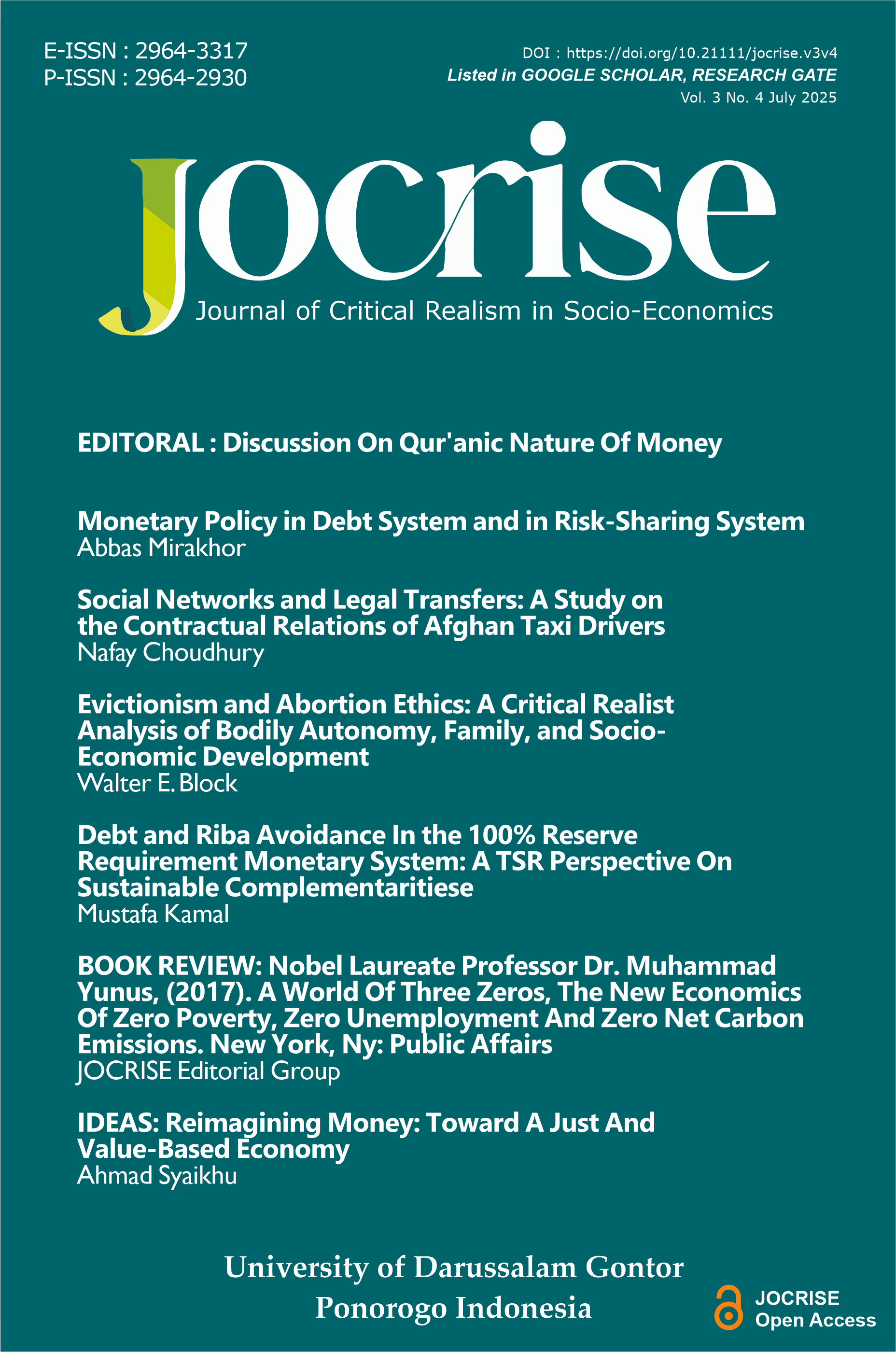
It Is Time, It Is Past Time, To Resolve The Abortion Debate
DOI:
https://doi.org/10.21111/jocrise.v3i04.86Keywords:
Abortion, pro-life, pro-choice, evictionism, Private Property RightsAbstract
Debates over bodily autonomy and abortion often polarize between pro-choice and pro-life positions. “Evictionism” offers a third perspective, framing pregnancy through the lens of property rights and bodily sovereignty: a woman has full ownership of her body, and a fetus is considered an innocent but unauthorized occupant. This study explores evictionism within a critical realist paradigm, recognizing the layered reality of biological processes, social structures, and technological possibilities. It situates the argument in socio-economic contexts where access to reproductive healthcare, legal frameworks, and medical technology shape women’s autonomy and fetal viability. Using a critical realist approach, this research employs theoretical analysis and socio-economic contextualization. The study identifies ontological layers of pregnancy (biological, legal, and cultural), explores causal mechanisms (property rights discourse, medical technologies enabling fetal survival, and social norms), and evaluates agency-structure interactions. Data are drawn from legal texts, bioethical literature, and socio-economic reports on reproductive healthcare access. The methodology emphasizes retroduction to uncover underlying mechanisms and assesses how technology and policy mediate ethical positions on evictionism. Findings indicate that evictionism functions as a contingent ethical framework, deeply dependent on material conditions. In socio-economic settings with advanced neonatal care, evictionism converges with pro-life outcomes in late-term pregnancies while maintaining bodily autonomy. In contexts with limited healthcare infrastructure, evictionism’s overlap with pro-choice outcomes becomes pronounced due to technological constraints. The analysis reveals that bodily autonomy cannot be abstracted from socio-economic realities and power structures. Critical realism highlights evictionism’s emancipatory potential while cautioning against reducing bodily integrity to property metaphors without addressing systemic inequalities.
References
Archer, Margaret S. Realist Social Theory: The Morphogenetic Approach. Cambridge: Cambridge University Press, 1995.
Archer, Margaret S. Realist Social Theory: The Morphogenetic Approach. Cambridge: Cambridge University Press, 1995.
Archer, Margaret S., Andrew Collier, and Douglas V. Porpora, eds. Critical Realism: Essential Readings. London: Routledge, 2013.
Archer, Margaret S., Andrew Collier, and Douglas V. Porpora, eds. Critical Realism: Essential Readings. London: Routledge, 2013.
Becker, Gary S. A Treatise on the Family. Cambridge, MA: Harvard University Press, 1981.
Becker, Gary S. A Treatise on the Family. Cambridge, MA: Harvard University Press, 1981.
Bhaskar, Roy. A Realist Theory of Science. Leeds: Leeds Books, 1978.
Bhaskar, Roy. A Realist Theory of Science. Leeds: Leeds Books, 1978.
Bhaskar, Roy. The Possibility of Naturalism: A Philosophical Critique of the Contemporary Human Sciences. Brighton: Harvester Press, 1979.
Bhaskar, Roy. The Possibility of Naturalism: A Philosophical Critique of the Contemporary Human Sciences. Brighton: Harvester Press, 1979.
Block, Walter, and Roy Whitehead. “Compromising the Uncompromisable: A Private Property Rights Approach to Resolving the Abortion Controversy.” Appalachian Law Review 4, no. 2 (2005): 1–45.
Block, Walter, and Roy Whitehead. “Compromising the Uncompromisable: A Private Property Rights Approach to Resolving the Abortion Controversy.” Appalachian Law Review 4, no. 2 (2005): 1–45.
Block, Walter. “Evictionism and Libertarianism: Abortion Reconsidered.” Journal of Libertarian Studies 17, no. 4 (2011): 1–15.
Bongaarts, John, and Susan C. Watkins. “Social Interactions and Contemporary Fertility Transitions.” Population and Development Review 22, no. 4 (1996): 639–682.
Bongaarts, John, and Susan C. Watkins. “Social Interactions and Contemporary Fertility Transitions.” Population and Development Review 22, no. 4 (1996): 639–682.
Cutler, David M., and Adriana Lleras-Muney. “Education and Health: Evaluating Theories and Evidence.” In Making Americans Healthier: Social and Economic Policy as Health Policy, edited by Robert F. Schoeni et al., 29–60. New York: Russell Sage Foundation, 2006.
Diaconescu, Radu, and Joseph Goguen. “Logical Foundations of Institutions.” Information and Computation 137, no. 2 (1998): 103–137.
Folbre, Nancy. Who Pays for the Kids? Gender and the Structures of Constraint. London: Routledge, 1994.
Folbre, Nancy. Who Pays for the Kids? Gender and the Structures of Constraint. London: Routledge, 1994.
Ginsburg, Faye. Contested Lives: The Abortion Debate in an American Community. Berkeley: University of California Press, 1987.
Goguen, Joseph, and Rod Burstall. “Institutions: Abstract Model Theory for Specification and Programming.” Journal of the ACM 39, no. 1 (1992): 95–146.
Kaelbling, Leslie Pack. “Foundations of Decision Theory for Ethics and Social Choice.” Artificial Intelligence 77, no. 2 (1996): 275–306.
Kinsella, N. Stephan. “How We Come To Own Ourselves.” Mises Daily Articles. Ludwig von Mises Institute, September 7, 2003.
Marquis, Don. “Why Abortion Is Immoral.” The Journal of Philosophy 86, no. 4 (1989): 183–202.
Meseguer, José. “General Logics.” In Logic Colloquium ’87, edited by H.-D. Ebbinghaus et al., 275–329. Amsterdam: North-Holland, 1989.
Schultz, Theodore W. Transforming Traditional Agriculture. New Haven: Yale University Press, 1974.
Schultz, Theodore W. Transforming Traditional Agriculture. New Haven: Yale University Press, 1974.
Sen, Amartya. Development as Freedom. New York: Alfred A. Knopf, 1999.
Sen, Amartya. Development as Freedom. New York: Alfred A. Knopf, 1999.
Singer, Peter. Practical Ethics. 3rd ed. Cambridge: Cambridge University Press, 2013.
Tarlecki, Andrzej. “Institution-Independent Model Theory.” In Category Theory and Computer Science, 329–352. Berlin: Springer, 1996.
Thomson, Judith Jarvis. “A Defense of Abortion.” Philosophy & Public Affairs 1, no. 1 (1971): 47–66.
Downloads
Submitted
Accepted
Published
How to Cite
Issue
Section
License
Copyright (c) 2025 Walter E. Block

This work is licensed under a Creative Commons Attribution-ShareAlike 4.0 International License.