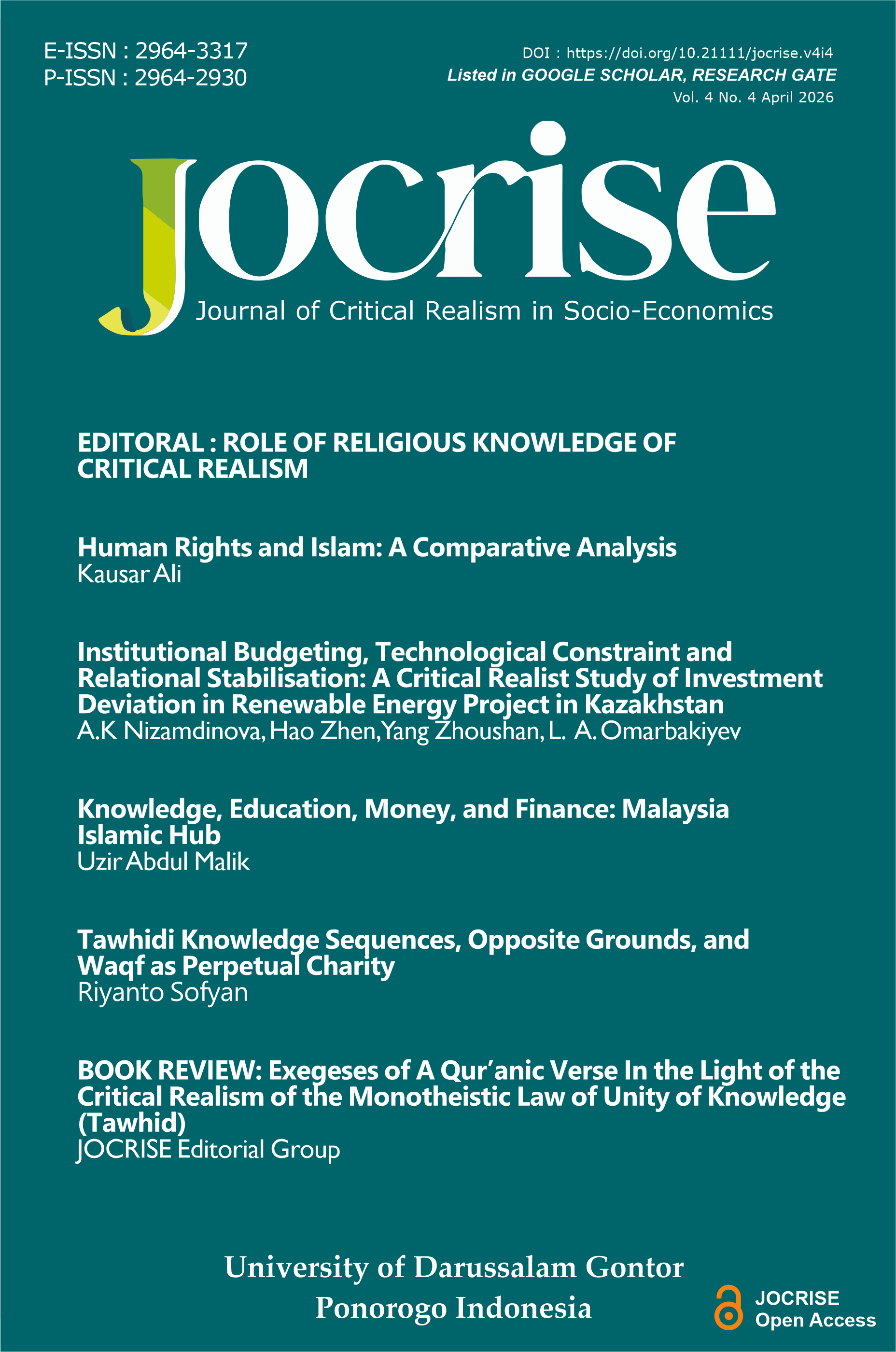
Institutional Budgeting, Technological Constraint and Relational Stabilisation: A Critical Realist Study of Investment Deviation in Renewable Energy Projects in Kazakhstan
DOI:
https://doi.org/10.21111/jocrise.v4i04.139Keywords:
Critical realism, circular causation, investment deviation, renewable energy, performative budgeting, KazakhstanAbstract
This study investigates the generative mechanisms underlying investment deviation and operational performance in renewable energy projects, moving beyond behavioural accounts toward a structural explanation grounded in critical realism. The methodology used a multiple-case retroduction design is applied to nine renewable energy projects (seven wind, two solar) in Kazakhstan, 2020–2025. Evidence is triangulated across business plans, completion audit reports, financial statements, monthly generation records, tariff schedules and ESG disclosures. Projects are anonymised as A–I. Data are analysed by retroduction and process tracing. The findings indicate three interacting mechanisms shape deviation and performance. First, performative budgeting practices, institutionalised safety margins attached to investment preference claims, pre-configure what is later recorded as “saving” or “overrun”. Second, differential predictability conditions arising from technological architecture explain why the solar case achieves near-zero deviation while wind cases disperse widely. Third, ESG practices operate as a dual-function relational mechanism, stabilising stakeholder relations while also imposing coordination costs. Apparent forecast accuracy in two recently commissioned projects reflects offsetting tariff and generation deviations rather than predictive precision. The patterns cannot be fully explained by behavioural accounts; they point to structurally embedded processes within open socio-economic systems. The study reframes investment deviation as an emergent outcome of interacting mechanisms within open socio-economic systems. It contributes to critical realist accounting research by integrating Choudhury’s circular causation with Bhaskarian stratification at project level.
References
Barnett, M. L. (2007). Stakeholder influence capacity and the variability of financial returns to corporate social responsibility. Academy of Management Review, 32(3), 794-816. https://doi.org/10.5465/amr.2007.25275520
Beach, D., & Pedersen, R. B. (2019). Process-tracing methods: Foundations and guidelines (2nd ed.). University of Michigan Press. https://www.press.umich.edu/9839094/process_tracing_methods
Bhaskar, R. (1975). A realist theory of science. Leeds Books. https://search.worldcat.org/title/2864747
Bhaskar, R. (1979). The possibility of naturalism. Harvester Press. https://search.worldcat.org/title/6142859
Choudhury, M. A. (2022). Circular causation. In Knowledge and the university (pp. 53-70). Springer. https://doi.org/10.1007/978-981-16-6986-6_3
Clarkson, P. M., Li, Y., Richardson, G. D., & Vasvari, F. P. (2011). Does it really pay to be green? Determinants and consequences of proactive environmental strategies. Journal of Accounting and Public Policy, 30(2), 122-144. https://doi.org/10.1016/j.jaccpubpol.2010.09.013
Eccles, R. G., Ioannou, I., & Serafeim, G. (2014). The impact of corporate sustainability on organizational processes and performance. Management Science, 60(11), 2835-2857. https://doi.org/10.1287/mnsc.2014.1984
Flyvbjerg, B. (2021). Top ten behavioral biases in project management: An overview. Project Management Journal, 52(6), 531-546. https://doi.org/10.1177/87569728211049046
Flyvbjerg, B., Bruzelius, N., & Rothengatter, W. (2003). Megaprojects and risk: An anatomy of ambition. Cambridge University Press. https://www.cambridge.org/core/books/megaprojects-and-risk/DB94C70CABF8A4FF38FC487AFDD90341
Friede, G., Busch, T., & Bassen, A. (2015). ESG and financial performance: Aggregated evidence from more than 2000 empirical studies. Journal of Sustainable Finance & Investment, 5(4), 210-233. https://doi.org/10.1080/20430795.2015.1118917
George, A. L., & Bennett, A. (2005). Case studies and theory development in the social sciences. MIT Press. https://mitpress.mit.edu/9780262572224/
Hirth, L. (2015). Market value of solar power: Is photovoltaics cost-competitive? IET Renewable Power Generation, 9(1), 37-45. https://doi.org/10.1049/iet-rpg.2014.0101
IEA. (2024). Renewables 2024: Analysis and forecast to 2030. International Energy Agency. https://www.iea.org/reports/renewables-2024
IRENA. (2023). Renewable power generation costs in 2022. International Renewable Energy Agency. https://www.irena.org/Publications/2023/Aug/Renewable-Power-Generation-Costs-in-2022
Kahneman, D. (2011). Thinking, fast and slow. Farrar, Straus and Giroux. https://us.macmillan.com/books/9780374533557/thinkingfastandslow
Khamzina, A., Ten, A., Mukatov, B., Assylkhan, A., Omirgaliyev, R., Mankovska, N., & Zhakiyev, N. (2025). Critical analysis of tariff policy and legislative measures for renewable energy development: Medium-term challenges and prospects of Kazakhstan. Economics and Policy, forthcoming. https://www.espublisher.com
Liu, J., Wang, Y., & Zhang, X. (2024). Forecasting errors and economic implications for renewable energy trading. Energy Economics, 130, 107295. https://doi.org/10.1016/j.eneco.2023.107295
MacKenzie, D. (2006). An engine, not a camera: How financial models shape markets. MIT Press. https://mitpress.mit.edu/9780262134606/
Miller, P., & Power, M. (2013). Accounting, organizing, and economizing: Connecting accounting research and organization theory. Academy of Management Annals, 7(1), 557-605. https://doi.org/10.5465/19416520.2013.783668
Modell, S. (2009). In defence of triangulation: A critical realist approach to mixed methods research in management accounting. Management Accounting Research, 20(3), 208-221. https://doi.org/10.1016/j.mar.2009.04.001
Modell, S. (2015). Making institutional accounting research critical: Dead end or new beginning? Accounting, Auditing & Accountability Journal, 28(5), 773-808. https://doi.org/10.1108/AAAJ-09-2013-1457
Modell, S. (2017). Critical realist accounting research: In search of its emancipatory potential. Critical Perspectives on Accounting, 42, 20-35. https://doi.org/10.1016/j.cpa.2016.03.001
Sayer, A. (2000). Realism and social science. Sage. https://doi.org/10.4135/9781446218730
Taleb, N. N. (2007). The black swan: The impact of the highly improbable. Random House. https://www.penguinrandomhouse.com/books/176226/the-black-swan-by-nassim-nicholas-taleb/
Yin, R. K. (2018). Case study research and applications: Design and methods (6th ed.). Sage. https://us.sagepub.com/en-us/nam/case-study-research-and-applications/book250150
Downloads
Submitted
Accepted
Published
How to Cite
Issue
Section
License
Copyright (c) 2026 A. K. Nizamdinova, Hao Zhen, Yang Zhuoshan, L. A. Omarbakiyev

This work is licensed under a Creative Commons Attribution-ShareAlike 4.0 International License.