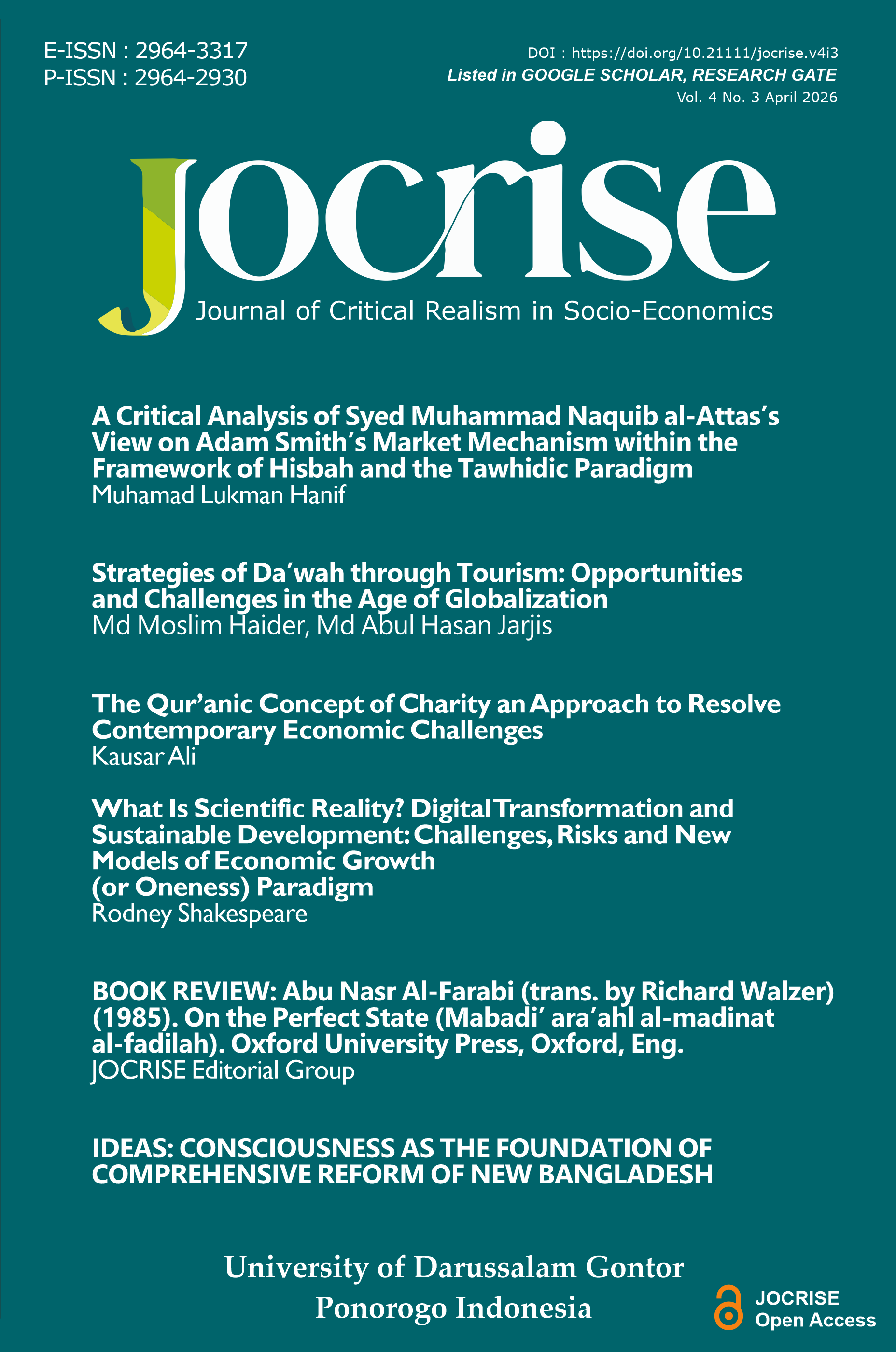
Digital Transformation and Sustainable Development: Challenges, Risks and New Models of Economic Growth
DOI:
https://doi.org/10.21111/jocrise.v4i03.129Keywords:
Digital Transformation, Sustainable Development, Fintech, ESG, KazakhstanAbstract
This research aims to identify key economic growth models shaped by digital transformation, assess associated risks, and determine the conditions for their compatibility with sustainable development principles, using Kazakhstan as a case study. A comparative-analytical and structural-functional approach is applied. The empirical base comprises data from the Agency for Strategic Planning of Kazakhstan, the National Bank of Kazakhstan, public reports of Kaspi.kz and Halyk Bank, and World Economic Forum Network Readiness Index (NRI) data for 2019–2024. The findings indicate that Digital transformation in Kazakhstan is developing asynchronously: the financial sector leads while industry and agriculture lag critically. The super-app business model generates sustainable growth but creates data monopolisation risks. ESG integration remains declarative without measurable KPIs. The digital tenge pilot opens prospects for enhanced fiscal transparency. The originality of this research for the first time, a comprehensive analysis of Kazakhstan's digital transformation is conducted through three interrelated dimensions economic growth, ESG integration, and external economic risks using scenario forecasting and case analysis of leading fintech players.
References
Acemoglu, D., & Robinson, J.A. (2012). Why nations fail: The origins of power, prosperity, and poverty. Crown Business.
Agency for Strategic Planning and Reforms of the Republic of Kazakhstan. (2024). Digital economy indicators of Kazakhstan 2023. ASPiR RK.
Auer, R., Cornelli, G., & Frost, J. (2020). Rise of the central bank digital currencies: Drivers, approaches and technologies. BIS Working Papers, No. 880. BIS.
Bank for International Settlements. (2021). CBDCs: An opportunity for the monetary system. BIS Annual Economic Report. BIS.
Berg, T., Burg, V., Gombovic, A., & Puri, M. (2020). On the rise of fintechs: Credit scoring using digital footprints. The Review of Financial Studies, 33(7), 2845–2897. https://doi.org/10.1093/rfs/hhz099
Bouveret, A. (2018). Cyber risk for the financial sector: A framework for quantitative assessment. IMF Working Paper, WP/18/143. International Monetary Fund.
Brynjolfsson, E., & McAfee, A. (2014). The second machine age: Work, progress, and prosperity in a time of brilliant technologies. W.W. Norton & Company.
Buckley, R.P., Arner, D.W., Zetzsche, D.A., & Selga, E. (2020). TechRisk. Singapore Journal of Legal Studies, 2020(1), 35–64.
Crisanto, J.C., & Prenio, J. (2020). Financial crime in times of Covid-19: AML and cyber resilience measures. FSI Briefs, No. 7. Financial Stability Institute, BIS.
Kaspi.kz JSC. (2024). Annual Report 2023. Kaspi.kz. https://kaspi.kz/ir
McKinsey Global Institute. (2023). The economic potential of generative AI: The next productivity frontier. McKinsey & Company.
OECD. (2023). OECD Employment Outlook 2023: Artificial intelligence and the labour market. OECD Publishing. https://doi.org/10.1787/08785bba-en
Philippon, T. (2019). On fintech and financial inclusion. NBER Working Paper, No. 26330. National Bureau of Economic Research. https://doi.org/10.3386/w26330
Rochet, J.-C., & Tirole, J. (2003). Platform competition in two-sided markets. Journal of the European Economic Association, 1(4), 990–1029. https://doi.org/10.1162/154247603322493212
Rodrik, D. (2011). The globalization paradox: Democracy and the future of the world economy. W.W. Norton & Company.
Stiglitz, J. (2019). People, power, and profits: Progressive capitalism for an age of discontent. W.W. Norton & Company.
Tapscott, D., & Tapscott, A. (2016). Blockchain revolution: How the technology behind Bitcoin is changing money, business, and the world. Portfolio/Penguin.
World Bank Group. (2022). Digital economy for Africa: Harnessing the digital economy for inclusive growth. World Bank.
Downloads
Submitted
Accepted
Published
How to Cite
Issue
Section
License
Copyright (c) 2026 Aliyeva Baglan Muratovna

This work is licensed under a Creative Commons Attribution-ShareAlike 4.0 International License.