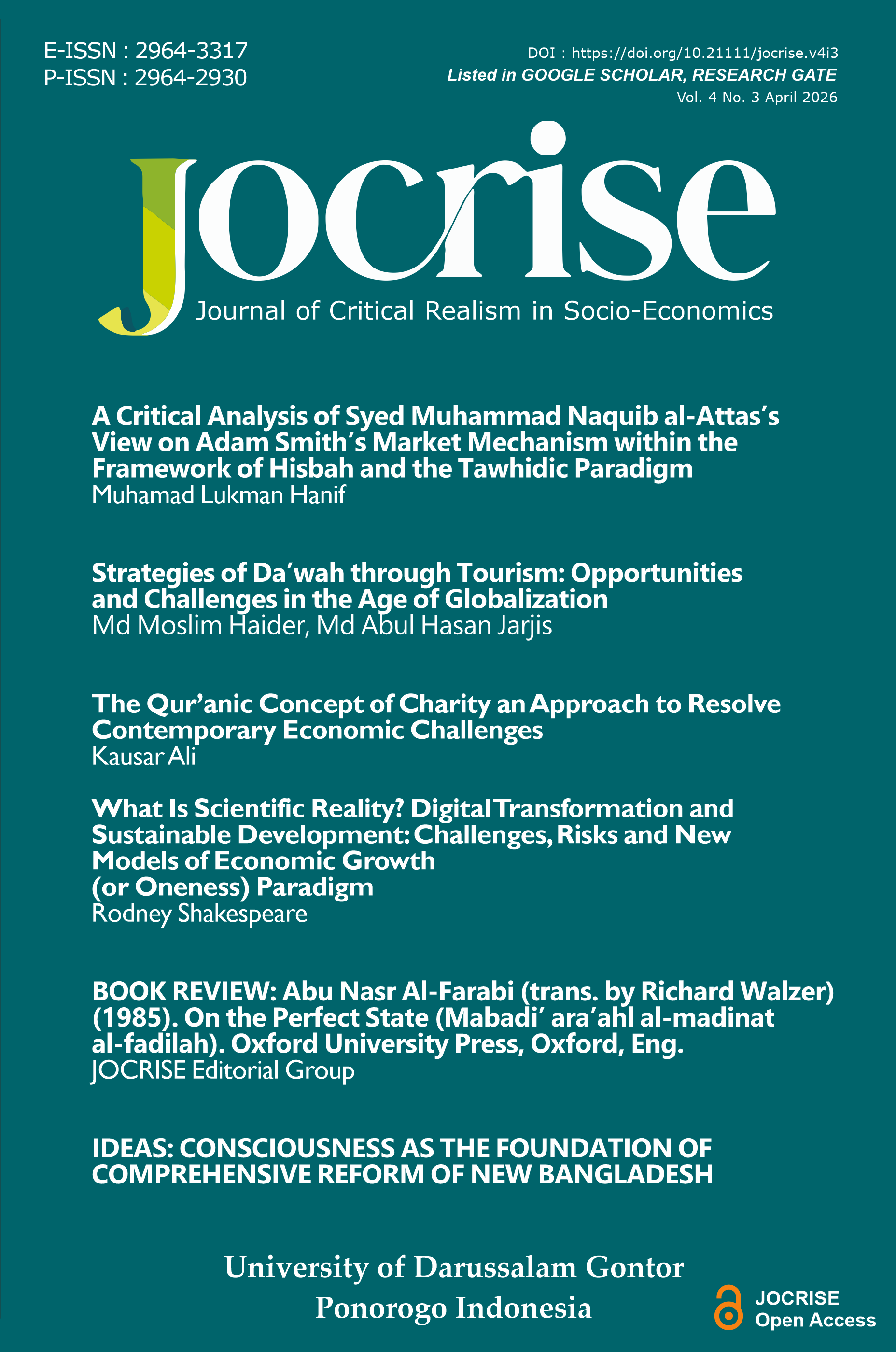
Strategies of Da’wah through Tourism: Opportunities and Challenges in the Age of Globalization
DOI:
https://doi.org/10.21111/jocrise.v4i03.125Keywords:
Halal Tourism, Halal Ecosystem, Da’wah, Islamic communication, Islamic hospitalityAbstract
Tourism has become an important platform for communicating Islamic values and strengthening Da‘wah through ethical, cultural, and Halal-based experiences. This study examines the role of Da‘wah in tourism through the development of a systematic Halal ecosystem that includes Halal hospitality, modest fashion, Islamic entertainment, ethical services, and effective Islamic communication. The study uses a qualitative method based on library research and document analysis. Data are collected from books, journal articles, reports, and other academic sources related to Halal tourism, Islamic lifestyle industries, Islamic communication, and Da‘wah practices. These sources are analyzed thematically to identify key concepts, opportunities, challenges, and strategies for integrating Da‘wah with tourism. The study finds that tourism can serve not only as an economic activity but also as a meaningful medium for presenting Islamic teachings, values, ethics, and ways of life to Muslim and non-Muslim tourists. A well-structured Halal ecosystem can strengthen Da‘wah by offering tourists a positive experience of Islam through services, behavior, environment, communication, and cultural presentation. Key elements such as Halal food, prayer facilities, modest dress, family-friendly entertainment, Islamic hospitality, and respectful communication help present Islam as peaceful and organized modern life. However, several challenges remain, including differences in Halal standards, weak stakeholder coordination, commercialization of Islamic symbols, globalization, and difficulties in communicating Islamic values in multicultural tourism settings. The study concludes that an integrated Halal tourism strategy based on Islamic principles, professional tourism management, stakeholder cooperation, and culturally sensitive Da‘wah communication can strengthen Halal tourism and promote Islamic values positively and practically.
References
Abdullah, A., & Ismail, M. (2013). Islamic media and its influence on society.
Al-Bayanuni, M. A. (1995). Al-Madkhal ila ‘ilm al-da‘wah. Mu’assasat al-Risalah.
Al-Qaradawi, Y. (1997). The lawful and the prohibited in Islam. Al-Falah Foundation.
Battour, M., & Ismail, M. N. (2016). Halal tourism: Concepts, practices, challenges and future. Tourism Management Perspectives, 19, 150–154.
Echchaibi, N. (2011). From audio tapes to video blogs: The delocalization of authority in Islam. Nations and Nationalism, 17(1), 25–44.
Eid, R., & El-Gohary, H. (2015). Muslim tourist perceived value in the hospitality and tourism industry. Tourism Management, 47, 108–120.
El-Gohary, H. (2016). Halal tourism, is it really halal? Tourism Management Perspectives, 19, 124–130.
Gökarıksel, B., & Secor, A. (2014). The veil, desire, and the gaze: Turning the inside out. Signs: Journal of Women in Culture and Society.
Hassan, R. (2015). Islam and the media: Global perspectives.
Henderson, J. C. (2016). Halal food, certification and halal tourism: Insights from Malaysia and Singapore. Tourism Management Perspectives, 19, 160–164.
Kamarudin, L. M., & Ismail, H. N. (2020). Pilgrimage and moral sustainability in Islamic tourism. International Journal of Religious Tourism and Pilgrimage, 8(3), 22–35.
Khan, M. I., & Haleem, A. (2016). Understanding ‘halal’ and halal certification and accreditation system. Journal of Islamic Marketing.
Lewis, R. (2015). Modest fashion: Styling bodies, mediating faith. I.B. Tauris.
Shakona, M., Almuhrzi, H. M., & Al-Balushi, H. (2022). Faith-based tourism and cultural sustainability. Journal of Sustainable Tourism, 30(5), 1043–1061.
Stephenson, M. L. (2014). Deciphering Islamic hospitality: Developments, challenges and opportunities. Tourism Management, 40, 155–164.
Suban, S. A., Madhan, K., & Shagirbasha, S. (2023). A bibliometric analysis of halal and Islamic tourism. International Hospitality Review, 37(2), 219–242.
Suhartanto, D., Dean, D., Wibisono, N., Astor, Y., Muflih, M., Kartikasari, A., & Hardiyanto, N. (2021). Tourist experience in halal tourism: What leads to loyalty? Current Issues in Tourism, 24(14), 1976–1990.
Tieman, M. (2011). The application of halal in supply chain management: In-depth interviews. Journal of Islamic Marketing, 2(2), 186–195.
Vargas-Sánchez, A., & Moral-Moral, M. (2019). Halal tourism: State of the art. Tourism Review, 74(3), 385–399.
Widodo, S., Situmorang, S. H., Lubis, A. N., & Lumbanraja, P. (2022). Halal tourism: Development, challenges and opportunities. Frontiers in Business and Economics, 1(2), 50–58.
Wilson, J. A. J., & Liu, J. (2010). Shaping the halal into a brand? Journal of Islamic Marketing, 1(2), 107–123.
Zamani-Farahani, H., & Henderson, J. C. (2010). Islamic tourism and managing tourism development in Islamic societies: The cases of Iran and Saudi Arabia. International Journal of Tourism Research, 12(1), 79–89.
Downloads
Submitted
Accepted
Published
How to Cite
Issue
Section
License
Copyright (c) 2026 Md Moslim Haider, MD Abdul Hasan Jarjis

This work is licensed under a Creative Commons Attribution-ShareAlike 4.0 International License.